

Rosenblatt (1964) characterized the creation of a poem in a group discussion as an evolving social process filled with chaotic, varied thoughts, inquiries, conjectures, and imaginative links, all rich in emotion. She regarded the poem as an "event in time," born from the interaction between a reader and a text, generating a novel experience. Similarly, improv thrives upon the existence of a scene that has never been and will never be again. To successfully co-create in this space, there is an inherent understanding of this transient stage, entirely reliant on the worlding in which all participants are collaboratively participating. Worlding in this sense refers to the usage of this term by Heidegger and Deleuze & Guattari, which describes how ensembles make present and create unique events in time. It involves the world's dynamic presencing through human consciousness and the temporary combining of heterogeneous elements (objects, ideas, people, nonhumans) into dynamic assemblages. (2012) This process of worlding can be likened to a rhizome, moving in every direction and emphasizing movement, dynamism, and the creation of differences over fixed structures. Worlding is not about representation but about sensing the qualities, rhythms, forces, relations, and movements of things. The goal is never to be entirely reproducible or present within the set of provided parameters. For these reasons, it becomes clear why scholars such as Diana Taylor approach their understanding of reading and language production through a lens informed by improv and performance.
Reading and understanding something can be done dozens of times, but will never, no matter the text, be replicable. If improv can teach us about ourselves, the space, and our audience, then it can surely inform our reading practices and serve as a lens through which we see that, even when alone, reading is never truly a solitary act. And according to this line of inquiry, it functions as an external method of performance in response to the worlding that the moment creates. To understand the state of being one inhabits when performing the act of reading, there is a certain assumed level of improvisational ethos, cultivating a shared commitment to affirming and validating the existence and experience of others. This shifts the act of reading as improv away from rationalistic, teleological, and prescriptive educational traditions, emphasizing the importance of being present, accepting what is there, and facilitating an energy of emergence.
To highlight the path toward understanding our relationality as readers as a collaborative one, which positions reading itself as an act of worlding, this exploration will first turn toward what exactly connects improv and collaborative readership. Then, it will utilize the framing provided through that exploration to showcase our embodied connection to one another when engaging in reading through an improvisational lens. An improvisational reading is less about implementing specific strategies and more about adopting a particular way of being together. (Tanner) It prioritizes the understanding, evocation, and management of shared emotional intensities, rather than focusing solely on the text's identity or intended meaning. Much of my knowledge of this notion is founded in the work of Samuel J. Tanner, in their article “Ways With Worlds: Bringing Improvisational Theater into Play With Reading”, in which Tanner presents us with five improv-inspired reading discussion practices, which are: Teaching as Invoking the Text, Teaching as Exchanging Offers (Yes, And), Teaching as Attuning, Teaching as Following Lines of Flight and, Teaching as Activating Embodied Energy. In this exploration, the key concepts to focus on are Teaching as Exchanging Offers and the "yes, and..." principle from improv, where every contribution (an offer) builds on the last, leading to a new collective creation. This approach necessitates cooperative listening, as participants must synchronize to collaboratively construct something uncertain in its outcome. Offers are viewed as gifts that advance the process moment by moment. Teaching as Attuning emphasizes being attentive and aware of the connections and interactions occurring among people, language, and objects in the present. It is about sensing the distinct quality and nature of the connections being established now, rather than concentrating on correctness or analysis. The teacher must pay attention to the unique energies and specific entanglements within the context. Similarly, Driscoll's work frames reading as a set of aesthetic and moral practices, emphasizing the actions that readers undertake. This focus on practice aligns with the approach of Tanner et al., who draw on improvisational practices to reimagine reading pedagogy. Both perspectives shift the focus from abstract understanding or fixed interpretation to the active, embodied engagement of individuals within a social context. Driscoll asks if all reading is compositional, a question also posed by Paul Norman.
Norman connects composition to the Latin componere, meaning "to put together," and suggests it's about the "organization of things". Driscoll notes that reading, as a complex and variable process, involves putting things together. Readers make organizational decisions that matter, affecting what is communicated and when, which are meaningful and potentially compositional. This concept of reading as compositional directly informs the "worlding" theory, which describes the collective co-composition of a new poem or world as a singular event. The compositional practices of readers play a significant role in the intricate and dynamic fusion of diverse elements that collectively shape these ever-evolving literary assemblages. Driscoll's work highlights the active engagement of readers, emphasizing that the reading experience is profoundly influenced by the readers' knowledge, experiences, and preconceived notions. This notion reinforces the 'worlding perspective,' which posits that readers are not merely passive recipients of texts; rather, they are active agents whose lived experiences and conscious decisions are crucial to the "coming-together" phenomenon that characterizes the poem or the constructed world within the text. Furthermore, the organizational choices made by readers, including their spontaneous "offers" in an improvisational context, serve as vital components in the dynamic co-creation of shared literary worlds during reading discussions.
In the interest in this feeling and this work, I ask that we turn to an act of improvisational performance that similarly straddles the line of genre or more specifically to this interpretation of the reader as actor, a chronotope—which in this work refers to an extension of the version offered via the work of Dan Ehrenfeld via the foundations of Bitzer and for all intents and purposes, exists as a representational chronotope, as interpreted by Ehrenfeld, signifying a time, place, or emotional state that illustrates the situation and reflects its embodied reaction. (Ehrenfeld, 2018). For reading to exist as a moment of improv, it must, in the opinion of this work, be analyzable as an ever-emergent chronotope. This is transferable to the act of reading as improv if we consider the act of reading as both conceptually unique to the reader themselves and as something simultaneously universalizable between all actors in the scenario. Reading is then in this way something that can only be done the same way once, our interactions with ourselves and the media we become part of in this exchange can be captured, but never truly replicated.
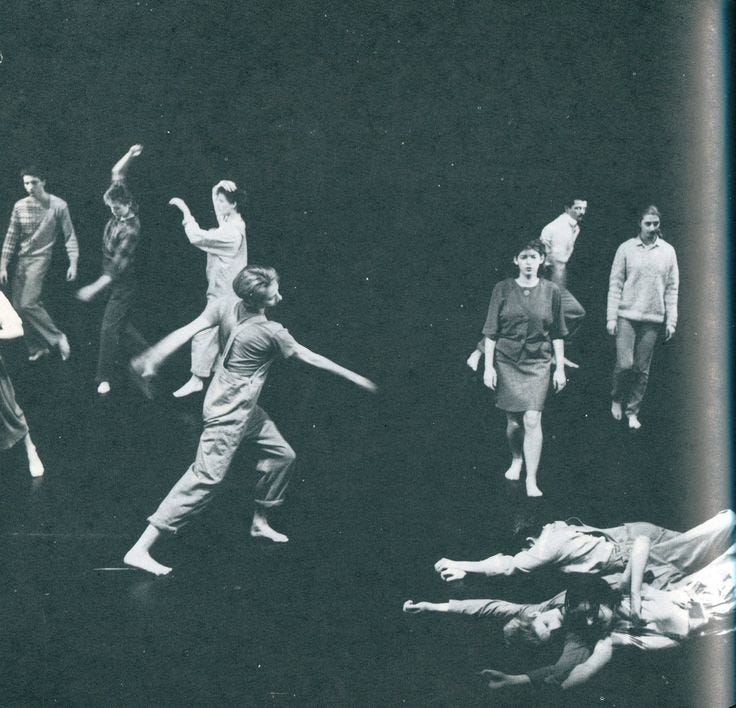
I’d like to zoom out and examine an instance of performance art that has informed my understanding of relationality and even personhood within a readership context. In 2014, performance scholar Claire Bishop assisted in a 5-hour-long performance piece that existed entirely within the confines of the Metropolitan Museum of Art (MoMA); this project involved notoriously an attempt to sell an unrecorded conversation for 1 million dollars and the use of disembodied voices echoing through white cubicle like rooms to showcase loss, and relationality in space. (Lemon) Nonetheless, the significant aspect of this endeavor emerged later, guided by Boris Charmatz, an innovative dancer who employs his body to investigate rhetoric, philosophy, and form. The initiative, called Expo Zéro, defies traditional dance exhibition formats by turning it into a five-hour extended improvisation. This work delves deeply into the dynamic interplay between dancers and their audience, blurring the boundaries of traditional roles; it often becomes ambiguous who is the performer and who is merely observing. The only guiding principle in this immersive experience was a call to perform without restriction. Bishop, one of the key figures associated with the project, articulated that during this moment in this unique space, several critical concepts were examined and laid bare: “Invisible histories of performance, questions of ownership and reperformance, improvisation versus scores, social dance and pedagogy were all put on the table (or, rather, the floor).” This has profound implications for understanding the nature of performance art today, prompting participants to reflect on their roles in the artistic process. (Bishop, Charmatz, Lemon)
Both reading and improv are acts that begin in the body, via an affective response, which allows the actor and reader to react readily and earnestly within the first second of receiving their prompt. The shared emphasis on embodiment and the activation of multiple senses directly connects Taylor's repertoire, the concept of intermedia, and the view of reading as improvisational worlding. Intermedia encompasses various performance art forms, such as Happenings and Fluxus Events, which are also event-based and fleeting. These works often foreground the "constancy of the physical aspect despite geographic variation". (Higgins) Together, they push back against traditional, often text-centric or purely visual models of understanding, such as relying solely on the archive or viewing reading as a passive decoding process, insisting that meaning-making and cultural experience are inherently physical and multisensory. The practice of improv teaches us to be present in our physical presence, gestures, and the exchange of embodied energy.
Reading as worlding calls for attending to "sensations" and the "physiological dimension" of the event. This is easily placed in conversation with the act of media consumption, namely via reading if situated within an intermedia informed perspective of how and why we read, Intermedia, particularly in the context of Fluxus Events, highlights the activation of multiple senses (hearing, touch, smell, taste, sight, kinetics) and the role of the body in performance and aesthetic experience. These works engage the "global sensorium". (Fluxus, Higgins) The understanding of improvisation as reading (worlding) emphasizes that reading is not just a cognitive or intellectual process but involves the reader's body, energy, and senses. The connection here lies in the shared valuation of the dynamic, temporal event over the static object. Just as Taylor argues that cultural memory resides significantly in live, embodied performances (repertoire) rather than solely in fixed documents (archive), and intermedia thrives in the live, often unpredictable performance space, improvisational reading emphasizes the reading act itself as an event. It is not just about the stable text but the unique, emergent experience of encountering it in a specific moment with specific energies and individuals. In my understanding of the archive, the repertoire, and intermedia as improvisation, these concepts intersect through the ways they challenge the idea of fixed categories or stable structures (such as the archive as a singular, authoritative source, traditional art categories, or the text as a sovereign object with a fixed meaning). Reading as worlding, illuminated by improvisation, is understood as a continuous process of forming multidimensional, multivectoral assemblages, where various elements contribute to the experience. This resonates with intermedia's emphasis on structural overlaps and Taylor's focus on the composite nature of repertoire practices.
Viewing reading through the lens of improvisational practice, akin to understanding the reader as an actor, fundamentally reshapes our comprehension of its embodied nature. This perspective transcends traditional views of reading as a purely cognitive or intellectual exercise, positioning it instead as a dynamic, physical, sensory, and relational event deeply intertwined with performance and world-making.
At its core, this approach views reading as a form of "worlding.” Much like the creation of a scene in improvisational theatre, reading is characterized as an "event in time," a unique "occurrence" or "happening" that brings together heterogeneous elements – the reader, the text, memories, affects, sensations, desires, and the environment – into temporary, dynamic assemblages. This process is likened to a rhizome, emphasizing movement, dynamism, and the continuous creation of differences rather than fixed structures or predictable outcomes. Just as improvisational performances are singular events that can never be truly replicated, each act of reading is viewed as a unique, unrepeatable experience.
This embodied understanding aligns significantly with Diana Taylor's work on the archive and the repertoire. Taylor highlights the repertoire – encompassing embodied practices like dance, gesture, and performance – as a vital system for cultural memory and knowledge transmission, existing alongside but distinct from the static archive of documents and objects. By understanding reading as an improvisational performance, we recognize it as an embodied practice that participates in this dynamic, live system of meaning-making, relying on physical presence and the exchange of embodied energy. The concept of intermedia provides a crucial framework for appreciating the multi-sensory dimension of embodied reading. Intermedia, which describes artworks that operate in the spaces between traditional art forms, emphasizes the physiological basis of all experience and calls for engaging the “global sensorium” – activating multiple senses simultaneously. Viewing reading through an intermedia-informed perspective reveals it not merely as a visual decoding of text, but as a potentially rich, cross-modal event that engages touch, sound, kinetics, and other senses alongside sight. This focus on the body and sensory engagement in intermedia directly supports the view of reading as an improvisational practice involving the reader’s body, energy, and sensations. Both intermedia and improvisational reading prioritize the dynamic, temporal event over the static object, resisting fixed categories and stable structures. Ultimately, viewing reading as an actor engaging in improvisational worlding reveals its intricate compositional and relational nature. Readers serve as active participants rather than passive recipients, making organizational decisions like improvisers who contribute "offers" to construct shared literary realms collectively. This viewpoint underscores the "embodied connection to one another" that arises when reading through an improvisational framework, highlighting the necessity of attending to shared emotional intensities and the "affirmational exchange of energies." Pedagogical methods such as "Teaching as Attuning" and "Teaching as Activating Embodied Energy" illustrate how this understanding translates into practices centered on perceiving connections and energizing the exchanges that occur during reading discussions. By adopting this perspective, we transform reading from a rational, prescriptive tradition into one that emphasizes presence, acceptance, and the dynamic energy of emergence.
Works Cited:
Bishop, Claire, et al. “Boris Charmatz, Expo Zéro, 2009. Performance View, Kunstsaele Berlin, July 12–13, 2014. Pichet Klunchun and Shelley Senter. Photo: Christopher Hewitt.” Artforum, Artforum, 26 Sept. 2023, www.artforum.com/columns/claire-bishop-8-222171/.
Bishop, Claire. “Claire Bishop.” Artforum, Artforum, 26 Sept. 2023, www.artforum.com/columns/claire-bishop-8-222171/.
Bishop, Claire. Artificial Hells: Participatory Art and the Politics of Spectatorship. Verso, 2012
Driscoll, Beth. What Readers Do: Aesthetic and Moral Practices of a Post-Digital Age. Bloomsbury Academic, 2024.
Ehrenfeld, Dan, et al. “Ecological Investments and the Circulation of Rhetoric: Studying the “Saving Knowledge” of Dr. Emma Walker’s Social Hygiene Lectures.” Methodologies for the Rhetoric of Health & Medicine, 1st ed., Routledge, United Kingdom, 2018, pp. 41–60.
Norman, Paul. “***click for More Information*** Reading as Performance / Reading as Composition.” Journal for Artistic Research, Journal for Artistic Research, 16 July 2020, www.researchcatalogue.net/view/498916/808120.
Reading Research Quarterly - 2020 - Tanner - Ways With Worlds Bringing Improvisational Theater Into Play With Reading.pdf
Schechner, Richard. Performance Theory. Routledge Classics, 2003.
Taylor, Diana, and Barbara Kirshenblatt-Gimblett. Interview with Diana Taylor: What Is Performance Studies? 2002.
Taylor, Diana. The Archive and the Repertoire: Performing Cultural Memory in the Americas. Duke University Press, 2007.