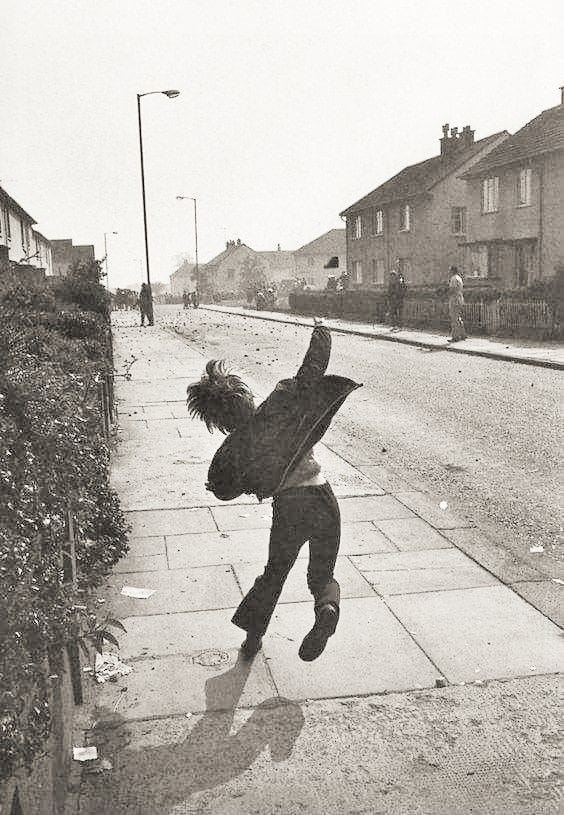
In honor of the 26th anniversary of the Good Friday Agreement, I want to dust off a short story that I wrote in conversation with memories and stories filtered to me through friends, family & acquaintances. None of us are free until we are all free.

Treading water:
Sit in the armchair that is far older than you, tuck your feet up under you. Accept the cup of tea offered by your cousin. Tell her that Earl Grey is fine, though you prefer Lyon’s. She’s seven months older than you; her brother and his friends were picked up by the Freedom Fighters and haven’t been heard from since. You let her worry and let her dote.
Remember, she had a thing for her brother’s friend, James. Don’t bring it up, they’ll never come home. At least not the same. Wait for the banshee to announce a death, three knocks at the door in the middle of the night. People will give you pitying looks when you’re home for the holidays. Your cousin will stand in the driveway, a cup of tea in hand, waiting for a ghost. Maybe forever.
So, when she looks at you and says, “Do you want to know how to survive this?”
Pretend you’re not nauseous, or nervous and say “Yes”, even if you don’t. Maybe she means The Troubles, maybe she means the hollow ache you feel when you look at her. Pretend you don’t already know the answers, even if you do. Your chest is full of water, but you’re a strong enough swimmer so you listen.
Let her tell you to keep your saint on you, but do not let them see it. Tuck the little coin sized medal into your collar. You were named for a saint, that’s harder to hide. Pick out a nickname. Do what you can. Let them mispronounce it, let them think it is two names instead of two syllables. Walk home from church a different way every week, do not linger in alley ways. Men will sneer and reach out to grab you, walk quickly. Do not wear green on the 12th of July. Do not wear a two-piece bathing costume, the boys will try and hold your head underwater, they heard a story that Catholics were once pagans and cannot float. You will scream and claw their arms bloody, but you will learn to tread water. Always cook dinner, enough for your neighbors. If not always order take-out from that one chipper by the old house on the hill. It has a yellow awning. They do a decent fry up and they’re decent enough people. They lost their son in a bombing; he was in your grade in primary school. He had red hair—like you, but brown eyes—not like you. You don’t remember his name, that’s ok. You were young.
(If she doesn’t get it out now, it’ll stay locked up forever in her head. She’s been doing that more and more.)
Keep clean towels, potable water, and kerosene in the mud room. Always hide things for the local boys. Try not to cry in public, and to never let them see your teeth. When you ask her, “Why?” she will tell you that “the yellowing makes you look poor.” Don’t bother telling her that you are poor; that’s not her point. Now you know that they don’t mind the Catholics with money. It’s the poor ones with too many kids that are too much. (You’ll wait for her to start up again and know that this is more for her than anyone else.)
When she says things like, “Did you hear there are only two Catholics in the entire Royal Ulster Constabulary?” Listen intently. You didn’t know this, and she’ll have more to say. “Did you know that they’re selling heroin out of Ballyfermot?”
To this, you will say, “Yes, I heard that Patrick Kelly brought back £30,000 of it, but I think he’s dead now.” She will nod. It’s been in the news all week.
It will fall quiet for ten minutes and then twenty. By now, your tea has gone cold. You’ll say her name softly for the third or fourth time, and maybe on the fifth time, her head will turn.
“Deidre?” She will look at you, there will be tears in both your eyes and she will start back in with:
Never wear tights with runs in them; you’ll look like the chit your grandmother lost your grandfather to. At this, you’ll smile knowingly. You were the only kid in your primary school with a step-grandmother. The church of England doesn’t mind divorce, but you? never recovered.
You often think fondly of primary school, though the things you remember do not always feel right. When your mind wanders, and you think of glass in the playground and needles and burning trashcans in the ladies’ washroom, of your first broken nose. Given to you by that Connelly kid and about how he asked you, “Do your parents even love you?”, and if “your Fenian brother is dead yet?” You’ll hit him, he’ll hit you harder. When you clench your jaw and say to him, “I know your uncle Lenny is a pervert,” he will hit you again, and you’ll know you were right about his uncle Lenny. You’ll always know you were right about your parents and Fenians and that the Connelly kid was deflecting and probably hears that shite at home. You’ll wrack your brain until your parents explain a Fenian is something you’ll always be. Your parents will put you in a catholic-only school the next year. You’ll make a few friends. Your temper will get the best of you often; people will laugh when you say you’re good at hiding your anger. They’re right. Work on that.
Vitriol fixes very little.
Take first aid at the church, do not get thrown out for giggling. You will need what they teach.
When she scoffs and says things like, “Be glad we don’t live in Derry or Dublin.”
Cringe, but hold your tongue as well as you can. You’ll remember the thick embossed envelope you received in the mail. How the weight of it, and its cream-colored paper could only mean one thing. You sent in the application on a whim when you felt as if you couldn’t take any more of the checkpoints and violence. Your hands shook, opening it, chest heaved and caught in your throat like an upchuck or a sob. The scrolling type font is pleased to inform you of your admittance to the University of Trinity, Dublin. That nine-by-eleven envelope now sits hauntingly between your mattress and the box spring, a secret or a boon. You hold it before bed each night, a hail Mary.
You’re going to Trinity Dublin next year; your family doesn’t know yet. You’ve only ever lied to the UFF, An garda, and your homeroom teacher. You wonder if you’re selfish, to even want to go. You heard a woman giving life advice on the radio say once that
“it’s okay to be selfish, every once in a while.”
You think that maybe this is what she meant.
Your mother will cry, and your older sister won’t even come to see you off. You’ll understand, she doesn’t like change. Your brother has already moved away. His detention changed him. By the time you come home, it’ll be Good Friday. The masses will have voted yes. To unify. You’ll have a four-year degree and a record for fighting. You’ve seen the shite they let happen to Catholics in the North. But you will make it back. Not like when you left, but back home.
And it will be you back here, once again sitting in the armchair drinking tea with your cousin.
Your chest will still feel like it is full of water when you’re alone, but you’ve learned to swim.
This time ready for when she says, “do you want to know how to survive this?”
Pretend you haven’t already been here before like she doesn’t tell you this every time you are home. You will wonder if she means survive being a woman, or Fenian or if she means watching her waste away. You won’t have it in you to ask her to tell you. She’s only seven months older than you. Sitting in the armchair, your eyes watching her from the window, you think that maybe she’s waiting for her brother or for James. Standing in the driveway. Looking for a ghost.