

The book of Margery Kempe is an experience, one that is best felt and then contextualized. There is so much to be gained from her work if it is navigated through the lens that Margery herself went through life with. The closest we as modern scholars come to embodying and exploring the work of Kempe’s expressive journey is through applying modern theories that partake in the same conscious queering of the writing and research form as she was. We come close to this through the emerging theory of embodiment rhetoric. Rhetorical embodiment theory finds its footing in the world on the cross-section between using one’s body as a body of work and sharing the knowledge gained from this methodology being applied to textual bodies. To examine The Book of Margery Kempe from a queer theory perspective, this paper will engage with a presentation given by Cesar Estien at the BEE seminar held at the University of Leeds. The presentation emphasizes the concept of reimagining the relationship between the researcher and the researched. This theory suggests allowing emotions and embodied reactions to guide research topics. An important tenant in this theory on queering the academic space resonates deeply with our understanding of The Book of Margery Kempe; for Margery, there was no practice of faith without her deeply embodied relationship with Jesus, and for her, there was no authentic way to showcase this devotion without her extreme emotions.
The act of embodying rhetoric is placed alongside the queer theory of research relationships, as posited by Ecologist Cesar Estien, which proposes a rejection of hierarchy within research, allowing the embodied reaction of the researcher to become part of the methodology itself. This seems to be a natural place to begin an exploration into the headspace and history that Margery Kempe lends to us as her audience. In the case of The Book of Margery Kempe, Margery serves in the role of researcher, and her unwavering commitment to both Jesus and the act of true religious pilgrimage is her life’s work and her research subject. To do justice to a figure that for many is viewed to be a feminist foremother and a genuinely relatable figure, the best course for this research project is to embody the theory that is being applied to Margery, engaging first with how the theory applies to her relationship to her work, the modern reaction to this work, and what that means for early modern gender as a subject area.
The paper will be divided into two sections. The first part will be a rhetorical analysis of The Book of Margery Kempe, focusing on an embodied reading of the text. This reading will give us an insight into Margery's goals for her work. Once we have understood Margery's perspective, the second part of the paper will engage in a creative writing embodied reaction section. I will craft poetic essay vignettes that mark the path of my emotional reaction to Margery’s impact on me. This reaction section will reimagine my relationship with the subject material through a queer research practice of emotion, embodiment, and reimagining of positionality. The analysis will be done in conversation with scholars such as N.B. Warren, Alison Torn, and Liz McAvoy. It will showcase the fluidity and applicability of embodiment theory for creative work. The paper aims to highlight the ways in which embodiment played a role in Margery's contributions to the rhetorical field and how these embodied moments showcased her desire to be remembered.
The culmination of this work will follow a line of thinking that encourages modern readers to listen to our initial embodied reaction and thus queer the academic space. Margery worked to embody and partake in what we now can perhaps call a queering of the religious relationship cohesively and intentionally. It is important to note here, for the sake of the more extensive work, that the act of queering in this paper is rooted in the Queer Theory, in which queering is a method of questioning the dominant culture by critiquing presumed binaries within spaces. The goal of this act is often subverting expectations and reimagining roles.

A Rhetorical Lens on Margery Kempe:
Four defining rhetorical tools are utilized in The Book of Margery Kempe, each informed by the embodiment of their unique rights. First, there is the nature of the narrative voice; this text is written through the aid of a scribe (Salthouse, who was the primary composer of the surviving fifteenth-century manuscript), which leaves room for speculation of authoritarian voice and indeed emphasizes the embodied moments in the text as something that Kempe intentionally showcases and includes. The shifts between the first and third person throughout this text create a layered body of work and sometimes make it unclear who is speaking to the audience, whether it is Margery, the scribe, or some combination of both. However, the ways in which Margery reiterates that the text is being relayed through the help of a scribe are conscious choices that are made to make a clear distinction that the ways in which Margery was acting were something she wanted to be marked down, to showcase the depth of her devotion to Christ. The communication through a scribe meant there was a witness, one that Margery could use to make it clear that her body was hers through which to communicate.
Then, we are presented with a fascinating interaction between Margery, who embodies the role of the subject, and Margery, who speaks as the author. Through this interaction, we are presented with an insightful exploration of Margery's physicality and genuine, if not deprecating, desire for self-reflection. One of the most significant moments in the text that showcases this duality of Margery’s identity throughout the writing and speaking process is when Margery is referred to as a "Creature," particularly at the beginning. This sets the tone for our imagination of Margery as someone who is embodying a form that is less than human after the birth that takes place in her twentieth year or perhaps as someone who takes on a non-human form and instead mirrors her body after that of the angels and devils from her visions. This subject is one that allows the reader to delve deeper into Margery's spiritual dialogues with Christ, which serve as an extension / and often allowance of her deepest desires. This portrayal of Margery is a testament to the author's exceptional writing skills and the depth of her understanding of the subject matter.
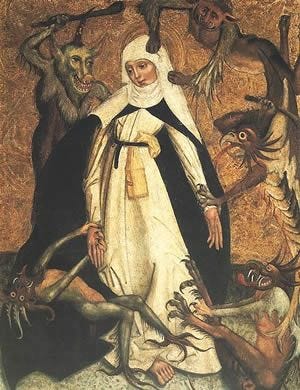
As we delve into the text, we can observe how Margery's clothing style changes over time due to her evolving relationship with Christ. She begins to dress in pure white, which is a garb that is typically associated with virginity. By doing so, Margery adopts a symbolic gesture that shows her commitment to purity and devotion to her faith. Through this act of embodying her commitment, she showcases her journey on her form, presenting it to anyone who sees her; this, in many ways, serves as a reclamation of a body that, over at least 14 years of marriage and pregnancy, was not hers to control. It seems that the decision to don white clothing was not one she came to quickly, having argued with Christ on what it would mean for her reputation that she would be painted as a hypocrite. This is something that scholars have noted to be her main point of disobedience in her relationship with Christ. In the journal Semantic Dimensions in Margery Kempe's 'Whyght Clothys,' Gunnel Cleve references this feeling that Margery had, saying, “She is a mother and wife, and those who know her will despise her and consider her a hypocrite if she starts wearing white clothes. The very color suggests purity and virginity.” (Cleve, 2). This apprehension and later acquiescence show exactly how intentional these bodily choices were for Margery; she knew how they would affect her life. However, her desire to showcase her devotion in her body of text and bodily form itself was eventually more critical to her.
Despite facing backlash for her actions, Margery remained steadfast in her commitment to dress and behave in a way that she believed was pure and reflective of her deep spirituality. This was most apparent during her pilgrimages, where the way that Margery dressed was broadcasted to other pilgrims and all whom they encountered on the journey. She believed that her dress was an outward expression of her inner devotion and served as a means of purifying herself before God. By positioning herself as purer than the other members of the pilgrimage through both dress and commitment to her prayers and deep reflection, Margery placed herself in the role of critic, not of the act itself but of the other pilgrims and what she viewed as their lack of reverence for the act that they were partaking in. Margery's decision to dress in a way that challenged the social norms of her time was not an act of rebellion against the pilgrimage itself but rather a means of reclaiming her body and asserting her own agency. By framing her actions as the will of Christ, through direct commands, she cites Christ as saying, “And daughter, I say to you that I want you to wear white clothes and no other color, for you shall dress according to my will.” (Kempe 67), Margery was able to process and reclaim her body as her own after years of her body being viewed as a vessel for the needs of others. Through this subversion of the act, Margery is effectively queering the act of pilgrimage and reinforcing her role as the researcher of Christ and her devotion as an extended act of research, reflection, and reevaluation.
Finally, perhaps the most essential facet of the text for us to explore is Margery's choices for her body through her weeping and her desire for chasteness—these are both shown to align her more closely with sainthood. After many years of marriage, when Margery entered her conscious relationship with faith and Christ, one of her most significant choices was to refrain from her marriage duties. In many ways, this choice was perhaps a moment of self-preservation; after over a decade of births and pregnancies, to refrain from being touched was arguably a haven for her. This is supported by how little Margery even references these children. It is even unclear how many of them lived past infancy. Motherhood was expected of her, but it was not a task that came quickly to her. She refers to her marriage and children as something that “nature-wished” for her, never something that she chose willingly. (Kempe 37) We know her to have suffered from post-partum depression and perhaps post-partum-psychosis after her last birth. The descriptions of the months leading up to and following this birth are vivid and bleak. Margery describes them as a time in which “she would have killed herself many a time at their promptings and been damned with them in Hell, and in witness of this she bit her hand so violently that the scar could be seen afterwards for her whole life.” (Kempe 38) Still, by choosing to include these details of how she tore at her form, she uses these moments to showcase a woman’s choice over her embodiment. Another way that Margery honored her embodiment was through her honest and visceral reactions, namely through what is often referred to as her wells of weeping. It would perhaps be apt to say that she weaponized her tears, but it would be just as accurate to say that she valued them for what they were able to do. Her weeping was something that often led to the discomfort of those around her; this discomfort once caused her fellow pilgrims to demand that she cease her wailing and, if she could, “make a new promise, and that is this: you shall not talk of the Gospels wherever we go, but shall sit still and make merry, as we do, at all mealtimes.” (Kempe 80). However, she refused to go quietly; it seemed there was no difference between devotion and emotion for her.
The exploration of The Book of Margery Kempe through the lens of rhetorical embodiment theory and queer research practices allows us to see a rich combination of Margery's experiences, struggles, and vividly emotional, spiritual journey. Through this analysis of Margery's narrative voice, her embodiment as both subject and author, her sartorial choices, and her deliberate actions to align herself with Christ's will, we gain deeper insights into the complexities of her identity and the societal constraints she navigated. Margery's conscious decision to embody her devotion through her physical appearance, her emotional reactions, and her defiance of societal norms are reflected in her unwavering commitment to her faith but also signify her agency in reclaiming her body and asserting ownership over how her story is told.
The Book of Margery Kempe is home to a narrative that challenges conventional understandings of gender roles, motherhood, and religious practices, and it is one that begs us to reconsider the boundaries imposed by societal expectations and the possibilities of self-expression and self-determination. By engaging with Margery's text through a queer lens that embraces embodied reactions and emotional resonance, there is space for us not only to her legacy as a feminist but also to acknowledge the transformative power of marginalized voices in any era in shaping social trends and challenging dominant narratives. Margery's embodiment of her journey is a testament to her spirit's resilience and quest for authenticity.
Our role as her modern audience is to continue her interrogation of exclusive spaces. Whether they be religious spheres or academic spaces, there is a particular need for queering and emotional expression to create and adapt an inclusive place. Only by allowing embodied perspectives to inform our understanding of history, literature, and culture can we fully understand the role of the body in our history. Margery Kempe and her narrative demonstrate the role of embodied rhetoric in disrupting traditional hierarchies of knowledge production and offer alternative modes of interpretation and education. In embracing our own embodied reactions and reimagining our positionality within academic discourse, we include ourselves in Margery’s legacy and amplify the voices of those who have been historically silenced or marginalized.
Embodiment & Exploration: A Creative Section:
This section is informed and inspired by Margery Kempe's writing with deep regard for her feelings, story, and exploration of faith. It will be a creative project, a personal poetic essay that oscillates between prose, response to text, and exploration of my research-oriented reaction to Margery Kempe and her wells of weeping. The form will be several short vignettes that are in conversation with my feelings as I researched and explored embodiment and The Book of Margery Kempe, some in somewhat direct conversation with the work of scholars, and other parts are fueled entirely by my reaction to the reactions of my peers to Margery’s presumed madness.
This section is modeled after diary entries like what would be found in my actual personal journal. However, instead of serving as an ode to my feelings organically, these poems/essays are responses to moments in The Book of Margery Kempe or our class discussion that proved significant in my relationship with the text. This is a very small-scale version of a journaling technique seen in embodied research that many poets and rhetoricians use as a form of data coding, often used to determine what stands out when they work their way through the research process. To understand Margery, I had to feel and write like her while writing about her in a messy, poetic, and earnest way and building the supporting theory from that journey. For the sake of this creative project, I entered the role of Margery, and she took the place of Christ as my research subject.
“To write them all down would perhaps be to impede more profitable things. These ones are written down to show the familiarity and goodness of our merciful Lord Christ Jesus rather than as a commendation of this creature.”
- The Book of Margery Kempe, page 70
1. I cannot bring myself to hate The Book of Margery Kempe, which is somewhat biographical and somewhat fantastical, and it is full of deep, deep wells of feeling—dramatic wells, exclamations of sorrow that feel more for show than for proper depth. My peers seemed to have knee-jerk reactions, and they see exactly where they seem to have issues with the narrator, with the title character herself: Margery Kempe. However, for me, it feels like I met Margery today; met is a stretch, and considering the possible and supposed contributions to the narration by Salthouse (a scribe and a man, and perhaps one not known for his dramatic flair?), maybe Margery is a bit of a stretch as well. But there is something about her. Nevertheless, today, I found a moment in the medieval world that reminded me of the notion that girlhood is ancient and forever and ever-changing, the same as it has ever been all at once. As I consider Margery's journey, I find myself wearing more pink, gasping in exclamation, crying on public transit, fishing my Saint Cristopher and Saint Barbara medals out of my jewelry box, and reclaiming the things that shaped the girl I can barely remember being. (skinned shins, chipped teeth, open-mouthed kisses on the cheeks of the ones I love) This relationship I built with this medieval woman feels so deeply like an acknowledgment that even as girls, we allowed ourselves to become so stuck in the in-between that we allowed ourselves to hate the joys the world would not allow us to have. Our latest novel in my first year of grad school, in a course I feel out of place and right at home.
“Her weeping was so profuse and so constant that many people assumed that she could weep and then leave off whenever she wanted, and therefore many people said she was a false hypocrite and that she wept in public for comfort and for worldly profit.”
-The Book of Margery Kempe, page 41
2. There is a part of me that wonders what she aimed to do here, what drama she was fueled by, and whom she was seeking to sway with her truly unlikable tone and depreciation of self; there was part of me that felt this, yes, but there is part of me, a deep part of me, that wishes I could be the same, feel the same, weep the same way, and still produce work that garners some facet of the academies’ respect. There are moments when the discussion strays to disparaging of her and her truth that I find my cheeks hot, find myself feeling like it is my overly emotional tendencies that we are picking apart as the fans blow and wescoe groans out around us.
There are people in this room who call her mad for expressing emotions in a way I long to do; there are people in this room who call her mad for womanhood and man-made sorrow, her body, not her own, her faith too much, too big, too loud, too much.
“So, she had such great compassion and such great pain to see our Lord’s pain that she could not keep herself from crying and roaring, though she could have died from it.”
- The book of Margery Kempe, page 81
3. People in this room do not see the girl in the woman. I am sitting in this room, at this table, picking the skin off my cuticles and wondering if she simply wanted an out, if this mysticism was thrust upon her just as much as marriage and madness were, and if that matters at all. If she, like me, had too many feelings to contain under her skin, if compassion was simply all she had to offer the world, she, like me, would be brought to tears, shuddering sobs upon watching the news. Between sobs and sorrows and headaches from reading much too many chapters of her life in low light, I am reminded of an article I read--Margery Kempe: Madwoman or Mystic – a Narrative Approach to the Representation of Madness and Mysticism in Medieval England By Alison Torn, when I first read it, I too was filled with curiosity, was she mad, was she magic? Was she a saint yet to be venerated? Does it matter at all? I have come to a somewhat middle-space sideways conclusion in which I have decided that maybe it does not matter.
Why should madness negate contribution if the madness hurts only oneself?
“So, when this creature had thus through grace come back to her right mind, she thought she was bound to God and that she would be His servant.”
- The Book of Margery Kempe, page 1
4. I must wonder if we are all creatures in some way as I sit here in plush armchairs, over-caffeinated and fresh off a phone call where I, too, wept, a phone call in which I called upon the work of this woman-called creature. I think there is a camaraderie, or perhaps a breaking down of hierarchy in this creatureliness; there is a peace that I have not felt in years when I consider the world in a way I think Margery would, with myself a creature and the things I cannot shape and cannot control as acts of those larger than I will ever be. Perhaps the point of Margery’s work was to remind us to let go of identity and instead build a path for something bigger than ourselves. Identity is inconsistent and fluid, yet intrinsically fundamental to our existence. To exist is to find some semblance of sameness and align yourself tightly to that group, hoping for a better chance of survival. Nevertheless, what is to be said about the sinking feeling of the in-between, Margery that in-between seemed to consume her, not saint, not woman, not pure, not sexual; she was stuck, trying to please man and God. This is a feeling that I think most women find themselves stuck in. Margery is so deeply familiar. There is a moment when I put myself into this conversation with Margery in which I realize that when reading about her days, I felt more at home than I have in maybe months or maybe years as I have floated through mourning periods and weeping periods and mental growth spurts in ever returning spring blues, under may rains and pruned roses, I have found, peace, or as close to it as a poet can find.
Works Cited:
Armstrong, Elizabeth Psakis. “‘Understanding by feeling’ in Margery Kempe’s book.” Margery Kempe, 5 July 2019, pp. 17–35, https://doi.org/10.4324/9780429264597-2.
Estien, Cesar, BEE Keynote Talk, Leeds Trinity University, 2022
Kempe, Margery, and B. A. Windeatt. The Book of Margery Kempe. Penguin Books, 2019.
McAvoy, Liz. “‘Aftyr Hyr Owyn Tunge’: Body, voice, and authority in The book of Margery Kempe.” Women’s Writing, vol. 9, no. 2, 1 July 2002, pp. 159–176, https://doi.org/10.1080/09699080200200161.
Torn, Alison. “Margery Kempe: Madwoman or Mystic – a Narrative Approach to the Representation of Madness and Mysticism in Medieval England.” Leeds Trinity University, University of Huddersfield, 1 Jan. 1970, research. Leeds trinity.ac.uk/en/publications/margery-kempe-madwoman-or-mystic-a-narrative-approach-to-the-repr.
Warren, N.B. (2007), Feminist Approaches to Middle English Religious Writing: The Cases Margery Kempe and Julian of Norwich. Literature Compass, 4: 1378-1396