

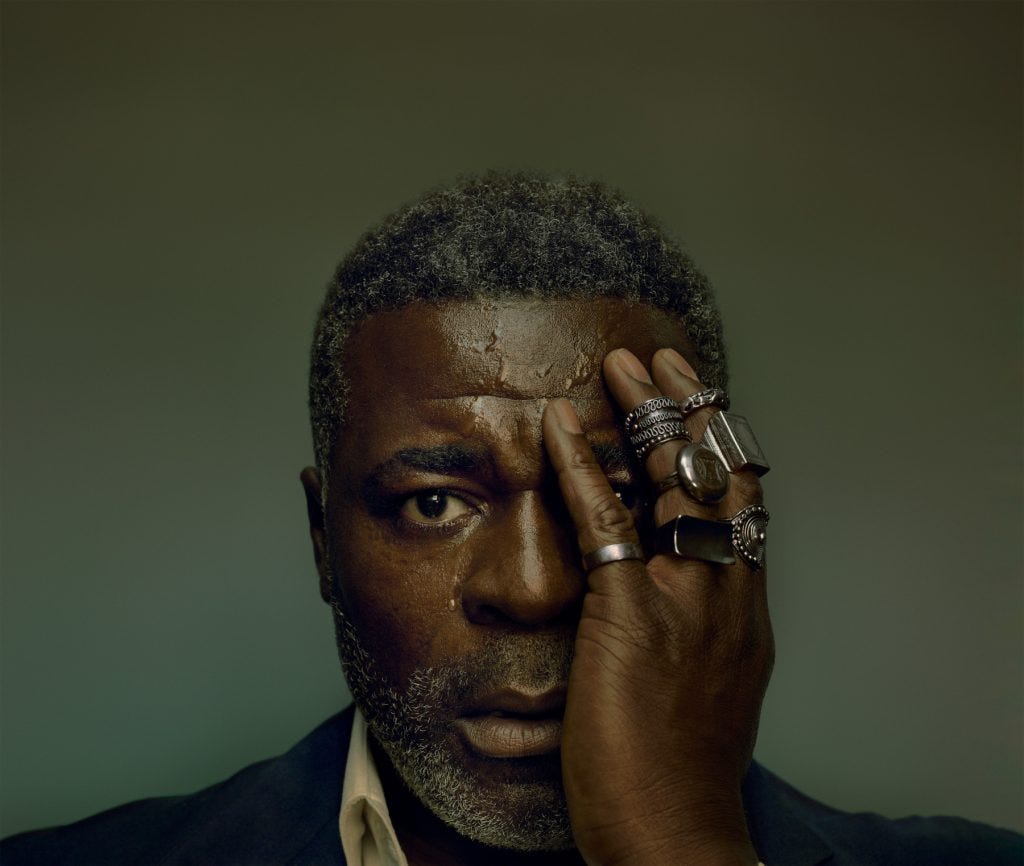
Take an actor from Dungannon, hand him a lit cigarette, and place him in the hands of a South African director, and from the proverbial ashes will rise the most gripping critique of the impacts of the empire I have ever seen. Fra Fee, what an actor you are!
I have always felt critical, confused, and utterly conflicted when interacting with media that comes from the empire that tore my family apart once upon a time. And yet, King Lear at the Almeida Theatre was one of the best works of art I have ever seen.
I can precisely pinpoint when I felt Farber’s directorial choices overtake my senses. It was the instant that the smoke cleared, and I recognized a Northern Irish actor playing the bastard son of the British Empire. The Second Fra Fee stepped onto that stage with an accent I hold in the back of my mouth and heart when someone asks me how I got my name, an accent that is so few and far between in the States that anyone who can recognize it is likely a second cousin.
It was a choice, an intentional moment in which Farber placed a man from Dungannon across the stage from Kent, played by Alec Newman (Dune), a Scottish actor whose character clung to the good in Lear despite the clear historical meaning—when Lear gives away his seat, Kent becomes a figment of the past.

In that instant, I knew that this version of Lear was looking at the concept of ego and empire in the eyes and challenging it to its core. The soldiers of France, with their paramilitary garb and the haze of fear cast from the single violin players slumped in corners, it was all a choice.
Danny Sapani (Killing Eve) is Lear, a corrupt, confused, and faltering ruler. But his fear, love, and immense stage presence shift the atmosphere of any stage he steps onto. In his first moments on the stage, set in front of a row of microphones, posh and well-mannered, it is clear he is a politician. Here to ask the most significant question—which child of his loves him the most? The instability of Lear—and England becomes clear when Cordelia rejects him. And the burst of violent rejection is woven into the very fiber of this play. The relationships and precise human moments of these ever-present historical characters are brought into a new, haunting level of clarity in this production that changes everything for the audience. The set, a dark landscape with controlled moments of light and glinting, shaking chains, paired with sparing, crescendo moments of singing and orchestral clashes, takes on a sliver of humanity itself as it shifts and changes with each moment of love, panic, and beautiful violence.

Farber’s plays are visceral and often shockingly modern. With casts in contemporary dress (see 2021’s Macbeth starring Saoirse Ronan) and interactive elements that leave the audience tearful and aching.
I spent over three hours of that three-and-a-half-hour play leaning over the chair in front of mine, mouth agape, tears in my eyes, genuinely transported. Historically, Lear is a play that refuses to be cut; it is long, often confusing, and must be done with two wildly interactive stories in mind. And Farber had no intention of cutting a second off this classic tragedy.