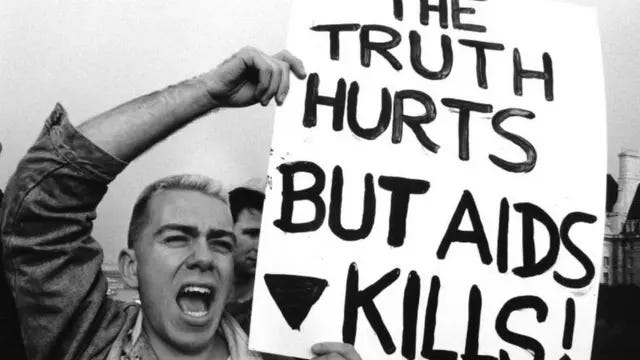
Perception and aesthetics are highly important to the novel The Line of Beauty; nearly every facet of the story is a pretty picture painted over a crumbling reality. Not unlike the British Empire. The London of the early 80s was one rife with political drama, class clashing, and a rich nightlife that stood in stark contrast to the growing HIV/AIDS epidemic. Nick is presented to us in the narrative as incredibly bright, having graduated with a first in English from Oxford, young, exciting, and yet caught up in his obsession with aesthetics. As he grows older and the story progresses, he is shown becoming more concerned with maintaining this search for beauty than he is about finishing his Ph.D. program.

Something he once was very passionate about. It seems Nick has developed his obsession with the beauty in life to entirely distract from the bleak reality that is closing in around him. However, this isn’t entirely a fault of his own making. English society can be of the mindset that making too much fuss is a cardinal sin. You are to be successful and mild-mannered; if you are not, you are to fake it. What happens when you look beneath that? Nick and his story, and all its beauty, are a way to show us the stark faults that the government had when approaching the AIDS crisis.
This fixation with aesthetics lies even in the name of the novel itself. An Ogee or “a line of beauty” is the double S form that Nick finds repeatedly. He finds it on the trousers of the attractive waiter, on the mirrors, and even in bed with Wani. He presents this Ogee as the name for their magazine together, cementing the idea that Nick is seeking beauty, even to the detriment of himself, holding a metaphorical mirror to the upper-class politics of London. Nick and his choices are an extensive illustration of hiding the ugly of a situation and how unsustainable that can be.
The novel is about more than Nick’s desire to seek beauty. The narrative is incredibly smart in the way that it layers social critique in flowering details. In a way, that is, for lack of a better word, English. The stark Englishness of Hollingsworth’s writing makes The Line of Beauty able to take on such giant issues within English politics and society. If not for subtlety and tact, the direct criticism of Thatcher, while welcome by some, would be incendiary instead of educational, especially in a novel catered to an English audience. The novel itself is split into three sections, in which the events of Nick’s life are placed into perspective with the political climate of the era. The first section, The Love Chord, begins in 1983 as Thatcher is winning her second election. Nick moves in with the class-conscious Fedden family and becomes a comfort source for their depressed daughter, Catherine. In this section of the novel, we see Nick fall in love with Leo, and subsequently meet Pete, Leo’s ex-lover, whom we quickly learn is dying of Aids. Pete serves as a harbinger of the losses to come and the tremendous political shift to occur. Nick’s closeness to the Fedden family allows him to be a firsthand witness to the ways the upper class truly thinks of the poorer members of English society. It also grants him insight into the shame behind their beautiful façade.
In the novel's Second section, the beauty around Nick begins to fissure. In this section, Nick accidentally catches Gerald in an affair with his secretary. It is where he begins his magazine with Wani, whom we see waste away from AIDS, all while ignoring the issue. Nick is visited by Leo’s sister, who tells Nick of Leo’s love for him but also brings a warning that Nick should get tested as Leo did die from AIDS. Through all these little ‘moments’ as Nick would call them, we see his world shift and the horrors of the AIDS crisis and class struggle begin to close in on him. And yet, none of this is enough to dull Nick’s eye for beauty. Hollingsworth purposefully ends the novel with the AIDS crisis closing in on Nick but also closing in on the reader.
Nick, who has begun in this second section to speak up for himself, goes so far as to rebuke a woman who says that “homosexuals will just have to learn...” by effectively outing himself, saying, “Yes, we will.” He rounds out this novel by doing the absurd, dancing with Thatcher whilst high on cocaine. The fact that he does this while possibly HIV+ is so incredibly poignant. The British government or even the royal family would barely utter the word AIDS, Thatcher even refusing to accept preventative programs that revolved around safe sex practices. The world practically shattered when Lady Diana shook the hands of an HIV+ person. So, Hollingsworth had Nick dancing with Thatcher, dancing with the devil, on his own terms, which made an incredible statement.
Hollingsworth uses Nick as an extended metaphor for English culture and learning when you must break away from the culture you know. The Line of Beauty is a commentary on whether a gay man can remain apolitical in a world that would just as soon watch you waste away. Nick’s supposed obsession with aesthetics is not one of his creations, but it eats him alive in a way reminiscent of a caged bird or an oppressed individual in an empire. The choice for Thatcher to be herself in this novel and not a dreamt-up Prime minister is a direct call out to the way England handled the deaths of roughly one thousand people a year.
The ambiguity in Nick’s diagnosis and probable death is a conscious choice, one that leaves the reader with hope but, more importantly, with an understanding that hope would never be enough to end an epidemic.